
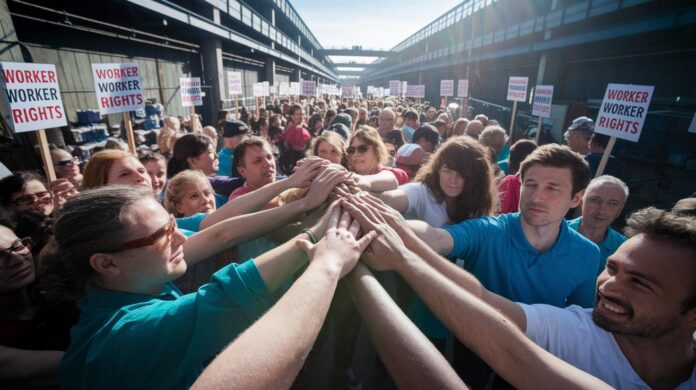

Are garment workers treated fairly? A worker rights group has joined forces with several organizations to support labor unity. The group works to enforce international labor standards and remove barriers that keep workers safe. They partner with universities, unions, and funders such as the Ford Foundation to ensure every worker is treated with dignity. Their united effort creates a clear path to fair treatment and accountability in factories worldwide.
Core Mission and Structure of the Worker Rights Consortium
The Worker Rights Consortium fights for fair treatment of garment workers worldwide. Its goal is to enforce international labor standards and protect worker rights. The group is known for supporting gender, racial, and ethnic equality, as well as disability rights and environmental justice. Major social justice funders like the Ford Foundation support its work. A spokesperson stated, "Before the Consortium set standards, many factory workers lacked basic safeguards, a situation we have changed." This pledge to protect workers drives the Consortium to hold brands accountable and push for labor justice.
The Consortium brings together NGOs, universities, unions, and brands. This diverse group strengthens their efforts to set and maintain labor standards. By combining expertise from various sectors, the Consortium promotes policy reforms and ensures factories follow the rules. Its teamwork approach makes it possible to secure workplace rights and drive lasting change for garment workers around the world.
Funding Models and Global Labor Funding of the Worker Rights Consortium

The Consortium manages resources through various grant programs that boost labor advocacy and local capacity. These programs combine network funding strategies with fresh funding models, opening up impact funding opportunities where they are needed most. Every grant supports community initiatives and makes sure funds reach regions that need strong worker rights protection.
| Program Name | Focus Area | Region |
|---|---|---|
| BUILD Program | Capacity building and policy reform | Andean Region |
| The Heartland Initiative | Grassroots engagement and network expansion | United States |
| Dignity and Justice Fund | Legal aid and worker support | Mexico & Central America |
| Social Bond | Emergency financial support for initiatives | East Africa |
| Ford Global Fellowship | Leadership development and research | India, Nepal & Sri Lanka |
| International Fellowships Program | Academic collaboration and international outreach | Middle East & North Africa |
The Consortium uses strict oversight to track every dollar spent, ensuring transparency and accountability. Its funding approach blends traditional grant management with flexible, region-specific adjustments that meet local challenges in worker rights. For instance, flexible allocation methods have enabled fast-track funding during pressing labor crises. A leader explained, "Just as a well-timed infusion of capital can stabilize a startup, targeted support can immediately bolster community labor initiatives." This strategy keeps funding aligned with real local needs, driving sustained and meaningful change.
Worker Rights Consortium’s Union Collaboration and Policy Influence
The Consortium works hand in hand with unions at both global and local levels. It joins forces with worker groups to launch union-led reviews that expose labor rule violations and call for tougher protections. A union representative recently said, "Partnering with the Consortium ensures our voices lead to meaningful change." This close collaboration builds a strong foundation for workplace justice and long-lasting harmony.
The Consortium relies on collective bargaining to drive its strong advocacy efforts. Union-led campaigns push factory managers to address wage delays and fix safety issues. The approach includes clear policy suggestions and coordinated reviews that have sparked new legal safeguards. In short, union talks are turned into direct action for worker protection.
Multi-stakeholder discussions also play a key role. The Consortium brings together factory managers, government officials, and civil society for open talks about monitoring employment laws. These joint efforts have paved the way for stronger legal reforms. Regular meetings with lawmakers and regulators ensure that worker concerns are heard at the highest levels. As a result, policy changes now put worker rights at the top of the agenda.
Worker Rights Consortium’s Supply Chain Auditing and Accountability Measures

The Consortium regularly reviews factory operations to ensure that workers receive fair treatment. They inspect production practices and enforce labor standards, pushing brands to adopt fair labor certification. This means factories must meet clear benchmarks for worker treatment, and inspections help identify when changes are needed.
The Consortium also runs a grievance system that lets workers report harassment and disputes quickly. This system gives employees direct access to support and speeds up issue resolution, reinforcing a strong commitment to accountability.
Transparency reports are published on a regular basis to show how well companies meet compliance standards. These reports reveal gaps in production practices and list corrective actions, such as adding interest on unpaid wages when needed. By detailing audit findings and follow-up measures, the Consortium holds brands publicly accountable and encourages proactive steps to address labor violations.
Case Study: Worker Rights Consortium and Nike’s Hong Seng Remediation
In February 2025, a close investigation of a Hong Seng garment factory uncovered serious issues like delayed wages and poor treatment. The probe began after several workers raised their concerns. It revealed unsafe conditions that led the Worker Rights Consortium to issue clear recommendations. Nike soon accepted a remediation plan that mirrored these recommendations. This case shows how fast, data-driven checks can expose critical labor problems and push companies toward accountability.
Nike’s plan required the payment of 100% of lost wages to affected workers, following the Consortium’s long-standing advice. However, the settlement did not include interest on those delayed wages. Moreover, help for an exiled worker leader, forced out of Thailand under false criminal charges for his advocacy, was limited to a minimal, symbolic payment. This example highlights that even strong wage recovery steps may leave gaps in full financial restitution and support for workers fighting exploitation.
An analysis of the plan shows clear wins and notable drawbacks:
- Immediate wage recovery was secured, stressing the need for strict oversight in manufacturing.
- The absence of interest on unpaid wages leaves a gap in complete financial justice.
- Limited support for advocacy leaders indicates broader challenges in ensuring full reparative measures.
This case underlines that while corrective actions can improve workplace conditions, ongoing vigilance and stronger financial safeguards are essential for lasting brand accountability.
Worker Rights Consortium’s Research Initiatives and Global Engagement

The Consortium builds its policy and advocacy work on strong, evidence-based research. It manages learning libraries and evaluates programs like Ford’s BUILD Initiative and Disability Rights Moves Forward. These reviews track work conditions and drive studies that lead to practical reforms. Detailed reports offer clear proof of labor challenges and support capacity-building efforts across the sector.
Regional work is a major part of the Consortium's strategy. They operate in the Andean Region, East Africa, India, Nepal & Sri Lanka, Mexico & Central America, the Middle East & North Africa, Southern Africa, the U.S., and West Africa. Local partners join in ongoing reviews and multi-stakeholder talks to design responsive engagement plans. These efforts help community organizations gain skills and influence changes in the system. The research also guides future expansion, ensuring new programs tackle emerging challenges and promote a unified approach to global worker rights.
Final Words
In the action, the article detailed the worker rights consortium's mission, funding models, union collaboration and supply chain accountability. It explained how the consortium leverages research and real-world cases to push for stronger workplace justice advocacy. The report breaks down complex processes into clear, actionable insights. Each segment aims to guide strategic decisions, emphasizing improved regulatory and competitive positioning. The worker rights consortium continues to make strides in promoting legal safeguards and fair labor practices across global supply chains.
FAQ
Who are the Worker Rights Consortium members?
The Worker Rights Consortium members include NGOs, unions, universities, and brands working together to promote workplace justice and enforce labor standards in global garment production.
What is the Worker Rights Consortium phone number?
The Worker Rights Consortium phone number is not widely published. Inquiries are typically directed through their official website or social media channels where contact details are provided.
What job opportunities are available with the Worker Rights Consortium?
The Worker Rights Consortium offers roles in research, advocacy, policy development, auditing, and coalition building, providing careers that contribute to enhancing accountability and justice for garment workers worldwide.
How can I submit complaints or feedback about the Worker Rights Consortium?
The Worker Rights Consortium manages complaints and feedback through its official website and designated contact points, ensuring that concerns about labor standards and accountability measures are addressed promptly.
What criticism has the Workers’ Rights Consortium received?
The Workers’ Rights Consortium has faced criticism for gaps in financial restitution and enforcement measures, with some arguing that remediation efforts do not fully cover the needs of affected workers.
What are the current workers’ rights issues today?
Workers’ rights issues today involve challenges such as securing fair wages, ensuring safe working conditions, and achieving proper labor representation, prompting ongoing efforts in policy reform and advocacy.
Which organizations support or partner with the Workers’ Rights Consortium?
Workers’ rights organizations and nonprofits, including unions, advocacy groups, and research institutions, partner with the Consortium to uphold labor standards and drive improvements in workplace conditions globally.