


Is digital labor replacing old work habits? In today’s business world, automation cuts hours of manual work down to seconds. AI agents and smart systems not only lower costs but also allow workers to focus on strategy and creative problem solving. This article looks at how digital labor shifts tasks to boost productivity and support growth. Can companies succeed by blending automation with human insight? Read on to see how modern companies are changing work practices.
Digital Labor’s Impact on Worker Productivity Trends

Digital labor uses AI agents, automation tools, and smart workflows to handle routine tasks in customer service, sales, HR, finance, and IT operations. Tasks that once took hours now finish in seconds. For example, an AI agent can quickly resolve a customer query, cutting wait times and reducing the need for manual work.
Companies reap immediate benefits with digital labor. Automating repetitive jobs lets businesses grow without hiring more people. This change frees employees to focus on strategy and creative tasks, which improves key performance metrics and overall cyber efficiency.
Automation also makes remote work simpler across different time zones. Digital tools ensure that workflows continue smoothly no matter where team members are based. Picture a global team where a report generated in one country instantly updates dashboards in another. This setup boosts collaboration and keeps operations steady.
Digital labor turns large amounts of data into practical insights. Automated systems gather and analyze data to predict trends, refine customer segmentation, and support product development. By streamlining these processes, companies can drive growth while avoiding the delays of manual processing.
In short, as companies adopt digital labor, they see productivity trends shift dramatically. Automation speeds up operations and positions businesses to respond nimbly in today’s fast-paced environment.
Automation, AI Restructuring, and Robotics Integration in Digital Labor Productivity
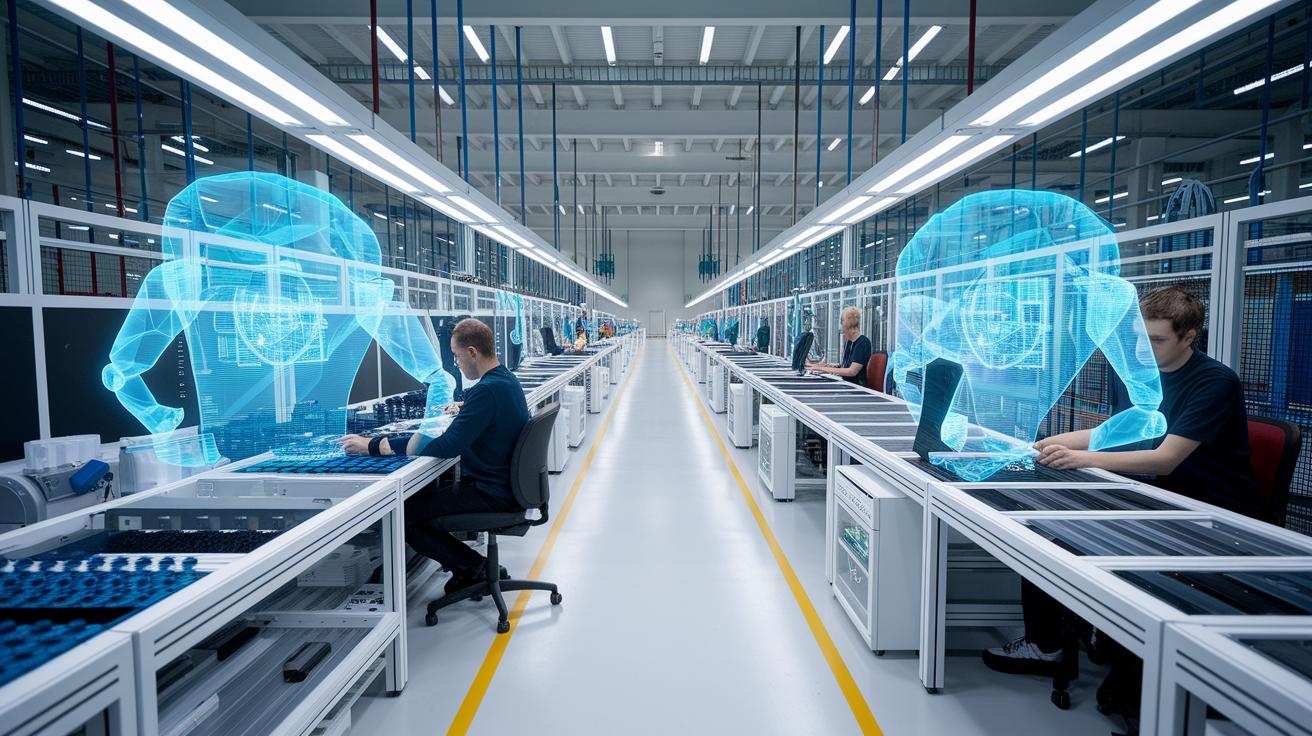
Digital labor boosts productivity by combining AI agents, rule-based automation, and robotics. These technologies work together to handle routine tasks and speed up product development. For instance, a generative design tool in manufacturing can finish design iterations in seconds, a process that once took hours. This speed enables faster trend forecasting and improved customer segmentation.
Predictive maintenance also plays a key role. AI tools constantly monitor equipment performance and flag issues before they become serious. This helps minimize downtime and keeps workflows steady. Robotics adds to these gains by performing repetitive tasks accurately while gathering real-time data for quick decision-making. In one automotive plant, using predictive analytics reduced unplanned maintenance by 40%, saving thousands in costs.
As these technologies develop, work roles are evolving. Employees now tackle complex problems, analyze large data sets, and interpret insights from AI systems. Upskilling in problem-solving and data interpretation is becoming essential. Strong engineering frameworks, like modern platform engineering practices, support these changes. This evolving digital labor ecosystem not only improves efficiency but also fuels strategic growth and targeted innovation.
Remote Collaboration and Telecommuting Optimization with Digital Labor

Digital labor helps remote teams work together seamlessly, no matter where they are. Since COVID-19 pushed many to work from home, smart collaboration tools and automated systems have become the backbone of global teams. For example, a mobile app might alert a support agent in Texas at the same time a technician in California updates their task. This real-time connection keeps everyone in sync.
Cloud-based tools and independent technology services mean teams can work effectively without a central office. These solutions allow decisions to be made closer to the action and make everyday communication easier. Frontline staff and office teams both gain from simple dashboards and connected workflows that offer continuous updates.
Key benefits include:
- Centralized communication hubs for mobile teams
- Continuous workflow management that crosses borders
- Technology that supports local decision-making regardless of location
Digital labor boosts individual performance while uniting diverse teams. By keeping a steady flow of updates and collaboration, it lets organizations overcome physical hurdles and drive productivity in a distributed work setting.
Digital Labor E-Analytics, Dashboard Design, and Real-Time Monitoring for Productivity Assessment

AI-driven tools for digital labor convert large data sets into practical, actionable insights. Companies now use integrated dashboards that pull information from customer support, sales, HR, and IT into one clear display. This setup helps managers monitor progress and adjust operations as soon as productivity slips.
Recent research from Netskope shows that the typical enterprise uses over 1,000 cloud apps, with nearly 93% not meeting enterprise standards. Relying on so many uncoordinated platforms can lead to login fatigue and scattered data views. Embedding real-time performance metrics in dashboards lets companies watch their operations continuously and fix issues right away.
Platform analytics gathers data from separate sources into one complete picture. For example, a dashboard might show task completion rates, error trends, and resource use at the same time. This comprehensive view helps decision-makers understand how digital labor boosts overall efficiency.
Managers often track these key metrics:
| Metric | Outcome |
|---|---|
| Task turnaround time | Reduced from hours to seconds |
| Cost savings | Lowered by reduced manual intervention |
| Resource allocation | Improved with live data insights |
A single dashboard refresh can transform thousands of data points into clear, strategic insights. This data-driven approach bridges the gap between complex operations and everyday decision-making, helping companies gauge the impact of digital labor on productivity and continuously enhance their performance.
Case Study: Salesforce Agentforce and Productivity Acceleration in Digital Labor

Salesforce Agentforce shows how using AI-driven processes can boost productivity by automating tasks from start to finish. The system uses AI agents to manage follow-ups, training, and customer support, reducing task completion times from minutes to seconds. One follow-up that once required several minutes now finishes in just seconds thanks to this automated workflow.
Agentforce works smoothly with existing systems so it fits right into a company's operations. This seamless integration lets businesses grow without needing to hire more staff because the AI handles routine tasks. Companies have reported fewer delays, which lets human workers focus on strategic and creative projects.
The platform also offers real-time insights that help teams manage workflows and make smarter decisions. By automating repetitive tasks, Agentforce lowers costs and speeds up innovation by freeing up valuable time. The end result is a flexible operation that can quickly adapt to market changes and evolving customer needs, clearly showing how digital labor can drive productivity growth.
Challenges, Ethical Oversight, and Capacity Solutions in Digital Labor Adoption

Digital labor is changing how work gets done, but it brings problems. Companies worry that automated systems may replace human workers. Relying too much on automated systems can weaken human judgment, and the costs to set up and maintain these systems can be high. One firm found that while automation shortened process times, it also overwhelmed employees with non-stop data alerts. A manager said, "Before fully automating, teams lost over 30% of their time dealing with scattered alerts."
Ethical oversight is key. Algorithms can favor certain outcomes, which may lead to unfair or legally questionable results. Companies should set up clear rules and monitoring systems to keep digital tools in check and ensure they work fairly.
Practical solutions include:
- Developing strong training and upskilling programs.
- Simplifying data processes and linking them with automation.
- Creating governance rules to reduce information overload and avoid cultural shifts.
By taking these steps, companies can enjoy the benefits of digital labor while keeping their workforce skilled and supported.
Strategic Recommendations and Corporate AI Strategy for Maximizing Digital Labor Productivity

Organizations looking to improve digital labor productivity should invest in ongoing skill-building programs. Upskilling in data interpretation and problem-solving gives employees the tools to work with advanced analytics while still keeping human oversight in automated tasks.
Designing clear process maps helps streamline workflows and lets companies adapt quickly. Pairing automated systems with human judgment keeps quality high and ensures accountability. Setting up simple governance rules, ethical guidelines, and transparent oversight builds trust and cuts down on risks.
Executives should match automation with current processes by setting clear, measurable targets. For instance, regular performance checkpoints make automation a strategic tool. Leaders are encouraged to review their operations and implement training alongside workflow automation. This combined approach, blending technical education with process redesign, drives lasting productivity gains. Explore further governance options with a corporate ai strategy for more guidance on integrating these practices and maximizing growth.
Final Words
In the action, the post outlines how AI agents, automation tools, and intelligent workflows reshape tasks in various operations. It shows digital labor driving worker productivity trends by streamlining processes in customer service, HR, and remote collaboration. The piece highlights real-time monitoring, analytics frameworks, and innovations like the Salesforce Agentforce platform that accelerate efficiency. It also addresses challenges and ethical oversight, offering practical steps for smart integration. Digital labor and worker productivity trends remain central to fostering scalable growth and informed strategy in our evolving market.
FAQ
Q: What do digital labor and worker productivity trends in 2022 show?
A: The digital labor trends in 2022 reveal that automation tools and AI agents complete tasks in seconds, reducing costs and freeing workers for strategic activities, which boosts overall operational efficiency.
Q: What do remote and hybrid work productivity studies reveal since the pandemic?
A: The remote and hybrid work studies highlight improved productivity through flexible scheduling and advanced communication platforms, with surveys showing better employee engagement and measurable gains in output.
Q: How does AI increase productivity in the workplace?
A: AI increases productivity by automating routine tasks and analyzing data quickly, enabling workers to concentrate on complex, high-impact activities while streamlining overall workflow performance.